
Guide8 min read
What Is an EMP Attack and Why Should You Care?
An EMP could destroy every electronic device in your home in milliseconds. Here is what you need to know and how to protect yourself.
The terms "EMP" and "solar flare" are often used interchangeably in preparedness discussions, but they are distinct phenomena with different characteristics, different effects, and somewhat different protection requirements. Understanding the difference helps you make better decisions about how to protect your home and family.
An electromagnetic pulse (EMP) in the preparedness context typically refers to a nuclear EMP — the electromagnetic burst produced when a nuclear weapon is detonated at high altitude. A nuclear EMP has three components: E1 (a fast, high-voltage pulse lasting nanoseconds), E2 (similar to a lightning strike, arriving within a second), and E3 (a slower, longer-lasting disturbance similar to a geomagnetic storm).
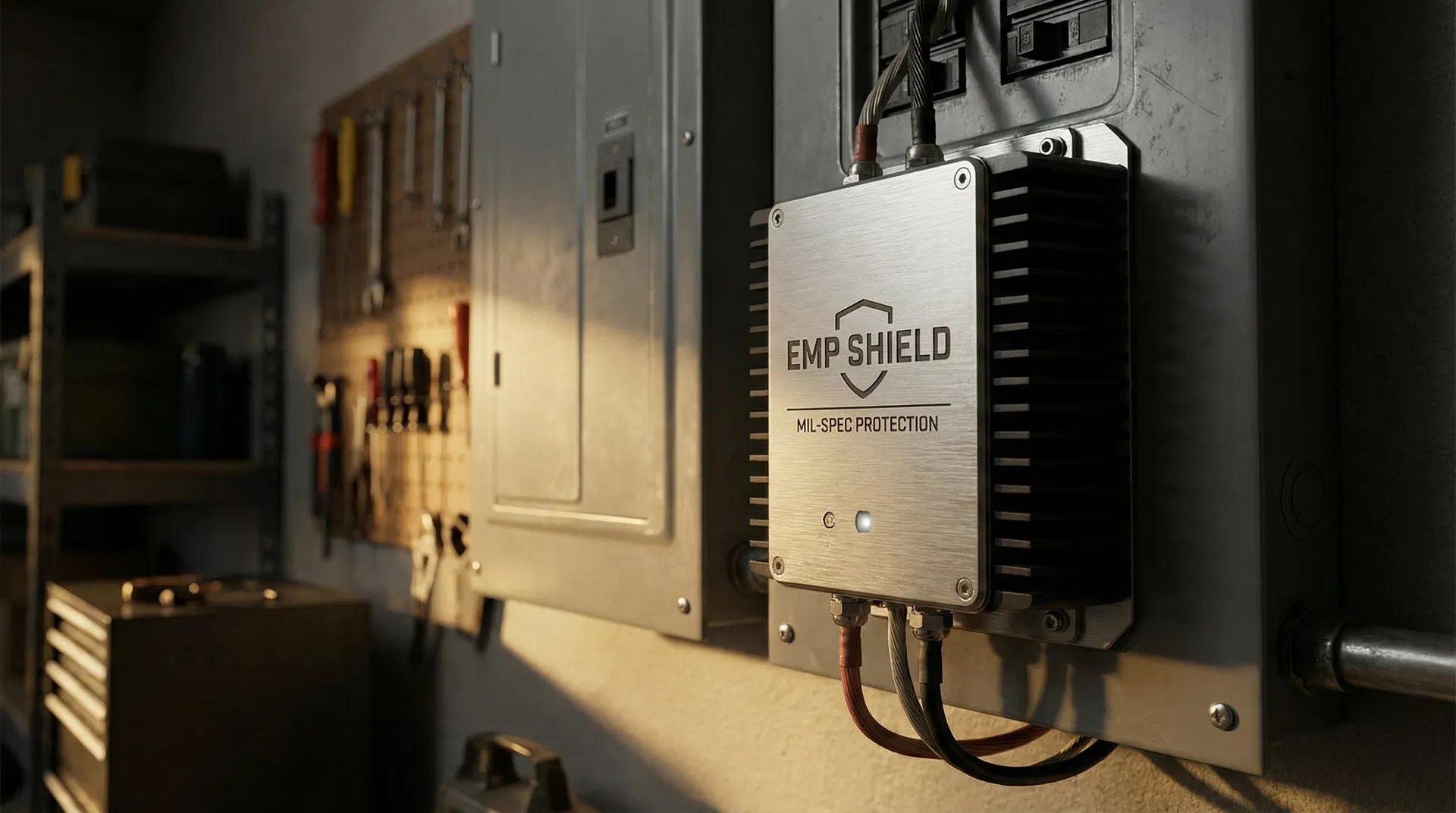
The E1 component is the most dangerous to electronics because it rises so fast that conventional surge protectors cannot respond in time. Only devices specifically designed for nanosecond-speed response — like EMP Shield — can stop E1.
A solar flare is an explosion on the sun's surface that releases energy across the electromagnetic spectrum. When a solar flare is directed toward Earth, it can produce a coronal mass ejection (CME) — a cloud of magnetized plasma that, when it reaches Earth, causes a geomagnetic disturbance (GMD). A severe GMD can induce large currents in long conductors like power lines and pipelines, potentially damaging transformers and causing widespread, long-duration power outages.
The most famous example is the 1859 Carrington Event, which caused telegraph systems across North America and Europe to fail and even catch fire. A Carrington-scale event today would cause catastrophic damage to the power grid. The 1989 Quebec blackout, caused by a much smaller geomagnetic storm, left 6 million people without power for nine hours.
The primary difference is speed. A nuclear EMP's E1 component rises in nanoseconds — far faster than any natural electromagnetic event. A geomagnetic disturbance from a solar flare develops over hours to days, giving some time for protective action (utilities can take transformers offline to protect them, for example). This means that protection against a nuclear EMP (like EMP Shield) also protects against solar flares, but the reverse is not necessarily true — a standard surge protector that handles solar flare effects may not respond fast enough for a nuclear EMP.
A major geomagnetic disturbance from a solar flare is significantly more likely than a nuclear EMP attack in any given year. Scientists estimate a 12% probability of a Carrington-scale solar storm occurring in any given decade. A nuclear EMP attack, while a real strategic threat, requires a nation-state actor willing to escalate to nuclear use. Both threats are worth protecting against, and fortunately, the same protection (EMP Shield) covers both.
An EMP could destroy every electronic device in your home in milliseconds. Here is what you need to know and how to protect yourself.
A practical, step-by-step guide to EMP-proofing your home — from whole-home protection devices to Faraday cages and backup power.
Everything you need in a 72-hour emergency kit — food, water, shelter, communication, and medical — with a complete checklist.